
Interior design blog
How to create a luxury terrace that comes alive at dusk
Summer nights in the mountains: how to create a luxury terrace that comes alive at dusk
There's a moment on summer nights in La Cerdanya that changes everything: when the sun finally sets behind the Cadí, the temperature drops a few degrees, the sky fills with a depth you never see in the city, and the terrace stops being a place you pass through and becomes the centre of the evening. If that terrace is well designed, you'll stay out until one in the morning without realising. If it isn't, you'll be back inside within twenty minutes.
At Marina & Co we have spent years working on terraces for high-end properties in La Cerdanya and the Catalan Pyrenees, and we have learned that a mountain terrace that works at night is the result of very specific decisions: about architecture, materials, light and textiles. Not luck or improvisation.
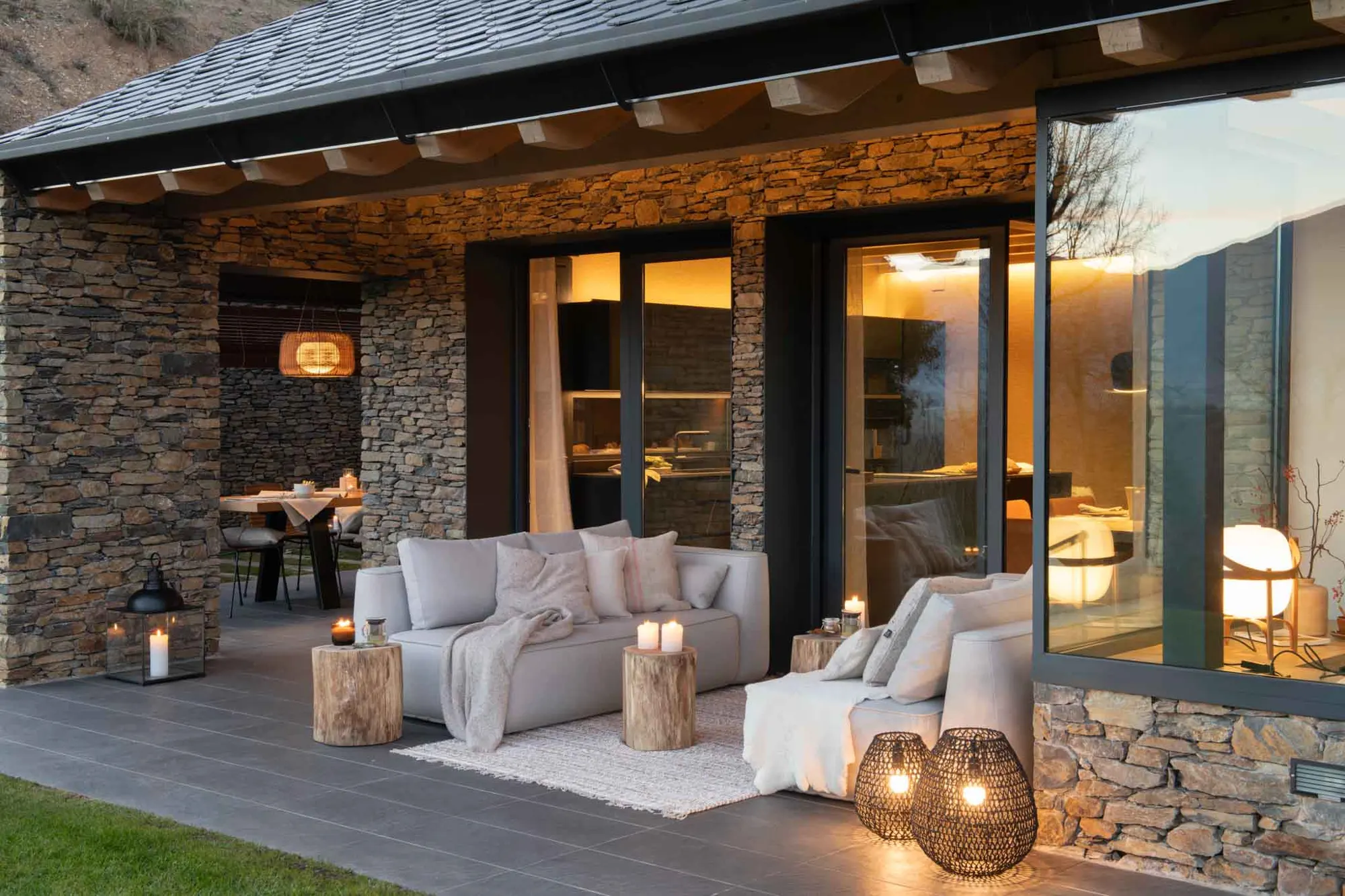
In the project you see in these images, every element has a reason. Let's break them down.
A mountain terrace that only works by day is only half a terrace. The best summer nights happen outdoors, and the space has to be ready for them.
01. Natural stone as the soul of the space
The natural stone cladding outside, in this case local slate and schist laid in an irregular bond, is the decision that defines the character of the whole terrace. It isn't decoration: it's structure, history, territory. A natural stone façade like this anchors the house to the mountain landscape with a solidity no manufactured material can imitate.
Natural stone also works extraordinarily well at night. When warm light grazes it at a low angle, the textures multiply and the wall gains a sculptural depth you barely notice during the day. It's one of those materials that improves in the dark. In our projects in La Cerdanya, whenever the architecture allows, we choose local stone: it's sustainable, in keeping with the surroundings and has a beauty that needs no trends to justify it.
02. The roof: the element that makes it all possible
A covered terrace is perhaps the smartest decision anyone designing a mountain house can make. Without it, a dewy summer night or an afternoon summer storm automatically rules out using the outdoors. With it, the terrace works 365 days a year.
In this project, the slate roof with exposed wooden beams creates a perfect transition between inside and outside: you're outdoors, but sheltered. The wooden beams, the same material language we find inside the house, unify the architecture and keep the roof from feeling like an add-on. It's been part of the house from day one.
The height of the roof is calculated so as not to block the views from inside, so that the matt black aluminium frames frame the landscape like paintings, and so that the hanging lighting, the rattan lamp you can glimpse on the dining porch, sits at just the right height to create atmosphere without feeling oppressive.
03. Candlelight + electric light: the formula for perfect nights
This is the most impactful and most underrated piece of advice: on a luxury terrace at night, artificial light and candles don't compete, they complement each other. And the proportion matters a lot.
In the project you see here, three layers of light work together. First, the light coming from inside the house through the windows, warm and intense, turning the glass into a giant lantern and bringing the whole stone façade to life. Second, lantern-style outdoor lights, in black iron, in different heights and sizes, that define the edges of the space and create points of interest without lighting it evenly. And third, candles: grouped in odd numbers on the tree stumps used as side tables, and in metal floor lanterns, they create an intimate, body-height scale of light that no bulb can replicate.
The result is a terrace that seems lit by the atmosphere, not by spotlights. One that makes you lower your voice and stay. That's exactly the effect we're after.
04. Outdoor furniture: comfort without sacrificing design
The outdoor sofas in this project are a good example of what we mean by high-end outdoor furniture: upholstery in a very light neutral, almost ecru, almost off-white, that is highly weather-resistant, with a generous volume that invites you to stretch out, and cushions in pinks and beiges that add softness without being loud.
The natural tree stumps used as side tables are one of the smartest pieces in the composition. They aren't a cheap trick: they're a style decision that connects the space with the forest surrounding the house, introduces a low, organic scale perfect for candles, and contrasts very effectively with the clean line of the sofa. At Marina & Co we often use them in mountain projects precisely for the dialogue they create between the natural and the designed.
In the outdoor dining area, visible in the background, the dark solid-wood table with black iron chairs follows the same logic: materials with weight and history, which age well and which at night, under the rattan lamp, create a dinner scene straight out of a summer film you don't want to end.
05. The indoor-outdoor transition: the detail that ties it all together
One of the things we care most about in projects like this is the continuity between what happens inside and what happens outside. Large matt black aluminium frames, floor-to-ceiling doors and windows, do several jobs at once. They let the interior light bring the stone façade to life from within. They make the kitchen and living room visible from the terrace, creating a sense of depth and of a house that's alive. And when they're open, inside and outside literally become the same space.
That permeability is what turns a terrace into a true extension of the house, rather than an outdoor appendage. It's the difference between a property that has a terrace and a property where the terrace is part of how you live.
If you own or are designing a property in La Cerdanya or the Pyrenees and want the outside to live up to the inside, for your summer nights to reach that level, we'd be delighted to tell you how we do it.